Build around the note.
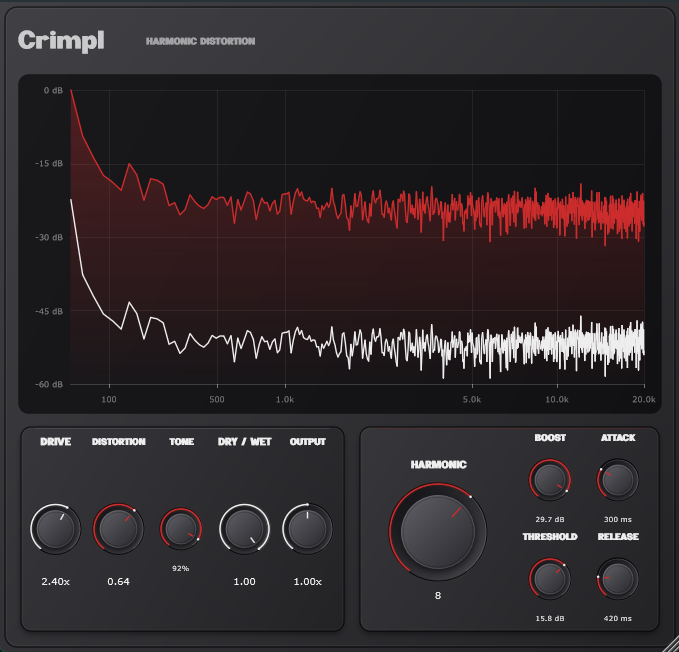
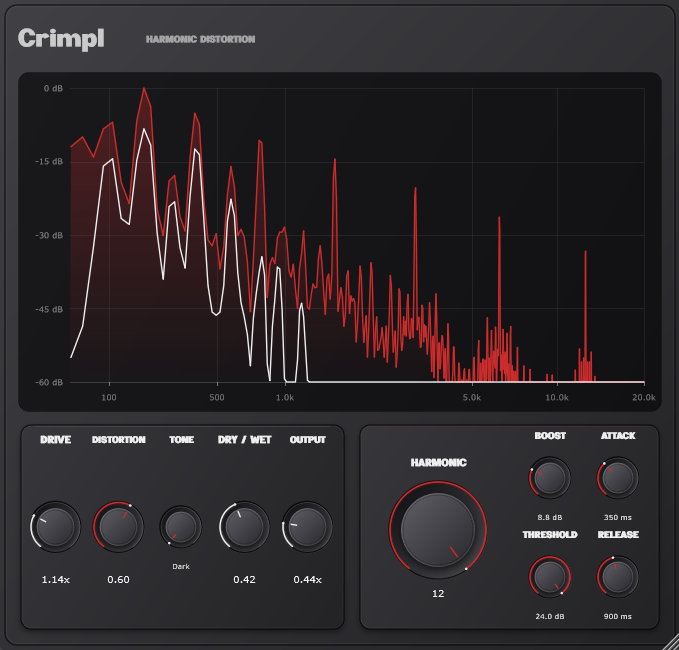
Request up to 12 octave voices with Harmonic and set their level with Boost. Threshold makes a competing note earn its place; Attack and Release control how the generated layers enter and leave.
A Bonaub product / Free harmonic distortion
Follow the note. Shape the grit.
Octave layers that follow your audio. Saturation that gives them character. A free, note-aware distortion effect with room for subtle reinforcement and rougher edges.
Windows 10 / 11 only, 64-bit · VST3 + standalone .exe · Version 1.0.0
About the effect
Created by J. Baudru (Bonoob). Made by Bonaub.
Crimpl listens for a prominent note in your incoming audio and builds a family of octave-related sine tones around it. The added layers follow chromatic musical notes, tuned to A4 = 440 Hz, before meeting the distortion stage.
Choose the number of voices, set their added level and shape their attack and release. Then drive, darken or brighten the distorted sound, blend it with the original and balance the output. One compact, resizable interface. Ten hands-on controls.
From clean to character
Audio-reactive layers meet a dedicated
distortion stage.
Request up to 12 octave voices with Harmonic and set their level with Boost. Threshold makes a competing note earn its place; Attack and Release control how the generated layers enter and leave.
Drive sets the original audio's wet-path input gain. Tanh saturation shapes that audio together with the octave layers, while Tone moves the distorted result from dark to bright.
Dry/Wet blends the complete processed chain with the untouched input. Output sets the final level. Watch the white input and red output spectrum curves as you work.
Inside Crimpl
Metallic controls. Red accents.
The same focused family as Sympl.
A relative note-switch threshold stabilizes selection. Independent attack and release envelopes soften or tighten the generated voices without changing the dry signal.
Start with a clearly pitched bass, lead or vocal line. Add a modest octave layer, then bring in distortion gradually. These are starting points, not bundled factory presets.
Automate the ten host-exposed parameters and restore settings with your DAW project. Windows 10 / 11, 64-bit VST3 and standalone .exe builds are available; the standalone processes audio, not MIDI notes.
Good to know
Crimpl is Windows 10 / 11 only, 64-bit. It includes a VST3 audio effect and a standalone .exe. Use a host that supports 64-bit VST3 audio effects, or open the executable to process audio outside a DAW. There is no macOS, Linux or Audio Unit release.
No. Crimpl is an audio effect. It follows one detected note at a time and adds octave-related sine tones, not pitch-shifted copies of your input. It does not detect chords, scales or a song's key. Clearly pitched, isolated sources are a useful starting point; dense mixes, quiet input and stereo cancellation can affect detection.
Threshold is the level advantage a challenger note needs before replacing the current note, not a gate or a smoothing time. Attack and Release shape the generated voices' amplitude. Setting Harmonic or Boost to zero removes those voices immediately, even with a long Release.
No. There is no output limiter or automatic gain compensation. Start with low Drive and Boost, monitor your levels and use Output to compensate. Distortion has no oversampling, and note detection has an analysis response time: it is not instantaneous or guaranteed alias-free.
Harmonic requests up to 12 voices, starting with the detected note and alternating lower and higher octaves. Voices outside the supported frequency range are skipped, so the actual count may be smaller. Boost sets the added tones' level; it is not a guaranteed increase in a measured spectrum peak.
Yes. Download Crimpl for free on Gumroad. Free does not imply open source or unrestricted redistribution; refer to the download page for release and usage terms.
Free harmonic distortion
Crimpl 1.0.0 · Windows 10 / 11 only, 64-bit · VST3 + standalone .exe.
Free download on Gumroad.